
Staph bacteria and severe childhood eczema: what Dr. Mohammed Tehami's research found
Why some children have constant eczema flares while others do not: the hidden role of Staphylococcus aureus, bacterial toxins, and what this means for modern treatment.
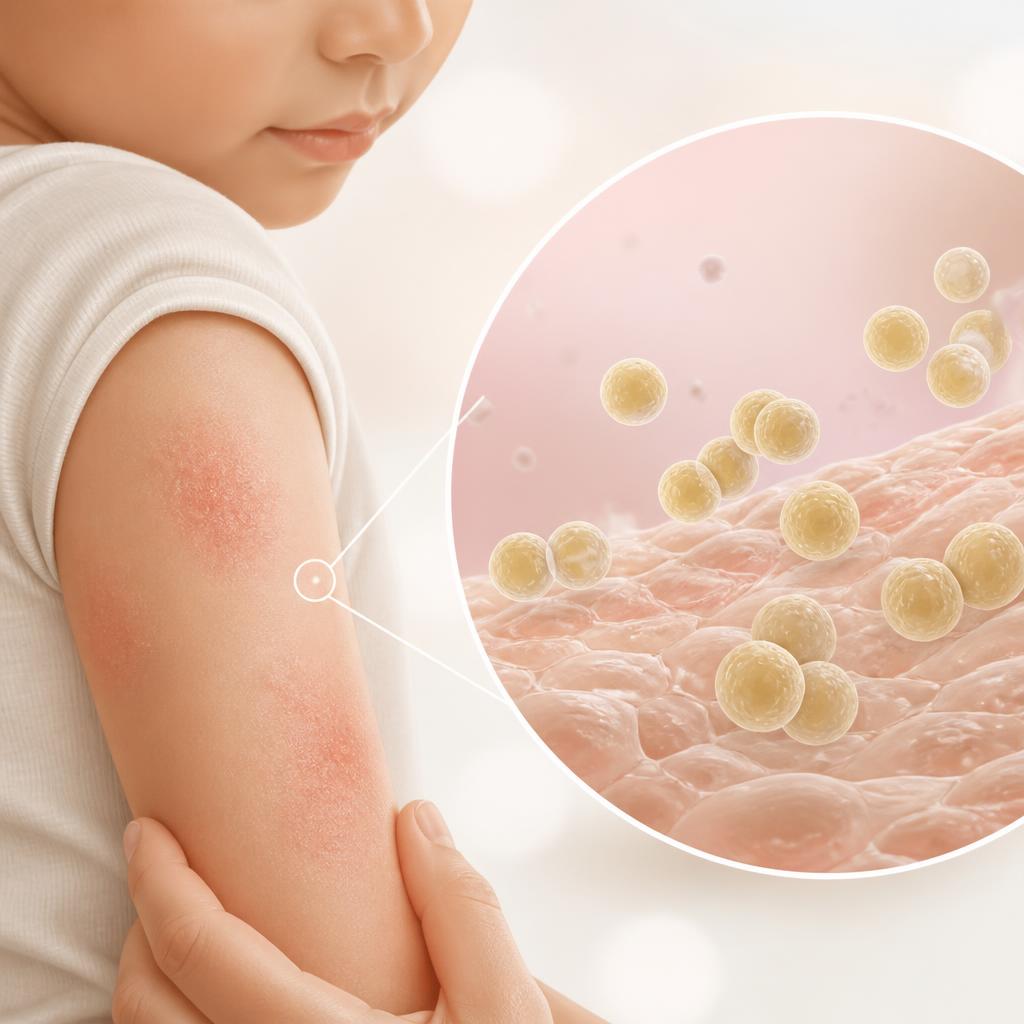
If your child has atopic dermatitis, you already know the cycle. A few calm days, then red, itchy patches that keep coming back, sometimes despite every cream in the pharmacy. Parents often blame food, weather, or stress. These can all matter, but one hidden driver is living right on the skin itself: a bacterium called Staphylococcus aureus. Dr. Mohammed Tehami, a Pediatric Dermatology Fellow and consultant dermatologist, co-authored a clinical study that puts a clear number on this link and explains why it changes how we treat severe eczema.
Key points
- Staphylococcus aureus colonized the skin of 73% of children with eczema in the study.
- The Hla toxin gene was found in 57.9% of patients.
- Higher bacterial colonization was directly linked to higher SCORAD eczema severity scores.
- Modern treatment should repair the barrier and address the skin microbiome, not just reduce inflammation.
- Dr. Mohammed Tehami co-authored this peer-reviewed pediatric dermatology research.
The hidden culprit on the skin
Staphylococcus aureus, often called Staph, is a common bacterium. Many healthy people carry it on their skin or in their nose without any problem. In children with eczema, the story is different. The skin barrier is weakened by dryness and inflammation, so Staph can settle in, multiply, and act like a troublemaker that keeps the immune system alert.
It is not just an infection you can see. Even when the skin looks only mildly affected, Staph can be present in large numbers and quietly drive more inflammation. This is why some children flare again soon after a steroid cream is stopped: the barrier and the microbiome were never fully repaired.
Inside the study: what the team discovered
The study, published in the Journal of Pediatric Perspectives at Mashhad University of Medical Sciences, looked at 52 children with atopic dermatitis. The researchers took skin swabs and used PCR testing, a laboratory method that reads the bacteria's DNA, to detect Staph and two specific toxin genes: Hla, which produces alpha-hemolysin, and TSST-1.
Eczema severity was measured using the SCORAD index, a universal scorecard dermatologists use worldwide. SCORAD combines how much skin is involved, how intense the redness and swelling are, and how much the itching disturbs sleep and daily life. A higher score means more severe disease.
The toxin connection: 73% colonization and worse eczema
The result was striking. Staphylococcus aureus was found on the skin of 73% of the children in the study. The most common toxin gene was Hla, present in 57.9% of patients. When the researchers compared bacterial load with SCORAD scores, they found a direct, statistically powerful link: more Staph colonization meant more severe eczema.
This matters because it moves the conversation beyond "dry skin" or "allergy alone." It shows that the bacteria are not innocent bystanders. Their toxins can damage skin cells, trigger immune responses, and make the eczema itself harder to control. For parents, this is a reason for hope: if we address the bacterial trigger, we can sometimes break the flare cycle.
What this means for your child's treatment
Treating severe pediatric eczema today is not only about applying a steroid cream and hoping for the best. A modern plan usually works on three fronts at the same time: calming inflammation, repairing the skin barrier, and managing the skin microbiome.
For children with frequent flares, heavy colonization, or weeping crusted patches, dermatologists may add targeted antiseptic baths, short courses of appropriate antibiotics when there is true infection, or other microbiome-directed approaches. Moisturizers are not optional; they are the foundation, because a stronger barrier leaves less room for Staph to settle.
Every child is different. Some need gentle maintenance only. Others need a step-by-step plan that changes with the season, the school environment, and the current flare. The goal is fewer flares, less scratching, better sleep, and less need for strong medicines over time.
Dr. Tehami's role in the research
Dr. Mohammed Tehami is a consultant dermatologist and Pediatric Dermatology Fellow. He is one of the co-authors of this peer-reviewed study, working alongside a team from Mashhad University of Medical Sciences that combined clinical dermatology with microbiology and molecular laboratory science.
His contribution sits on the clinical side of the work: examining children with atopic dermatitis, grading disease severity with the SCORAD index in a consistent and reproducible way, documenting flare patterns and treatment history, and helping interpret what the laboratory findings actually mean for a child sitting in a clinic room. Laboratory data on its own is only half the story. Someone has to translate a positive PCR result into a treatment decision for a five year old who cannot sleep because of itching.
This is the same approach he brings to his practice in Baghdad and to online consultations across Iraq: decisions guided by published evidence, not by trend or habit.
Why this kind of research matters
Atopic dermatitis is one of the most common chronic conditions of childhood, and severe cases carry a real burden: broken sleep, missed school, anxiety, and repeated courses of medication. For decades the standard explanation was genetics plus a defective barrier plus allergy. The skin microbiome was treated as background noise.
Research like this shifts the model. By measuring not only whether Staphylococcus aureus is present but which toxin genes it carries, the study links a specific microbial property to a specific clinical outcome. That is the difference between saying "bacteria may play a role" and showing that toxin producing strains track with measurable disease severity.
It also matters regionally. Most microbiome and eczema research comes from Europe, North America and East Asia. Data generated in the Middle East, on children living with our climate, our dust, our water quality and our prescribing habits, is scarce. Every study conducted here adds a data point that global guidelines currently lack, and it is why regional physicians contributing to peer-reviewed literature is not a formality but a genuine need.
How the study was actually done
Fifty two children with a confirmed diagnosis of atopic dermatitis were assessed. Each child had a standardised clinical examination and a SCORAD score recorded. Skin swabs were taken from affected areas and cultured, and isolates were then analysed with polymerase chain reaction, or PCR.
PCR amplifies tiny fragments of bacterial DNA so that specific genes can be identified with confidence. In this study the team looked for the Hla gene, which codes for alpha-hemolysin, and the TSST-1 gene, which codes for toxic shock syndrome toxin. These are not incidental markers. Alpha-hemolysin damages keratinocytes, the main cells of the outer skin layer, and helps break down the very barrier that eczema skin is already struggling to maintain.
Statistical analysis then compared toxin gene status and bacterial load against SCORAD scores, which is how the association with severity was established rather than assumed.
- 52 children with atopic dermatitis assessed clinically and microbiologically.
- SCORAD used as the severity measure, so results can be compared with other studies.
- PCR used to identify Staphylococcus aureus and its toxin genes, not just its presence.
- 73% colonisation rate, with Hla in 57.9% of positive patients.
The antibiotic question, and why we are careful
A natural reaction to "73% of these children have Staph on their skin" is to reach for antibiotics. That would be the wrong lesson to take from the data.
Colonisation is not the same as infection. Nearly every child with moderate to severe eczema carries some Staphylococcus aureus. Treating all of them with oral antibiotics does not produce lasting improvement in eczema that is not clinically infected, and it drives antimicrobial resistance, which is already a serious problem across the region where antibiotics are frequently sold without prescription.
What the study supports is smarter targeting: recognise the children who are heavily colonised or carrying toxin producing strains, treat true infection properly when it is present, and otherwise reduce bacterial load through barrier repair, anti-inflammatory control and, in selected cases, antiseptic measures prescribed and supervised by a dermatologist.
A practical plan parents can follow
The science becomes useful only when it changes what happens at home. For most children with moderate to severe eczema, the daily plan looks like this.
- Moisturise generously at least twice a day, and always within minutes of bathing. This is the single highest value habit.
- Short lukewarm baths rather than long hot ones, with a soap substitute instead of ordinary soap.
- Use the anti-inflammatory treatment your dermatologist prescribed for the full course, rather than stopping the moment the redness fades.
- Keep fingernails short and consider cotton clothing to reduce scratching damage that lets bacteria in.
- Watch for signs of true infection: weeping, honey coloured crusts, sudden worsening, pain or fever. These need review, not a bigger dose of steroid cream.
- Never start antibiotics or antiseptic baths on your own. Concentration and duration matter, and the wrong routine can irritate the skin further.
What the study does not claim
Good research is honest about its limits. This was a study of 52 children at one centre, which is a meaningful sample for a detailed molecular analysis but not large enough to write a global guideline from. It shows an association between colonisation, toxin genes and severity. It does not by itself prove that eliminating the bacteria will cure eczema, and it did not test one treatment against another.
What it does do is strengthen a growing body of international evidence pointing in the same direction, and it gives clinicians in this region locally generated data to reason with.
When to see a pediatric dermatologist
Consider a specialist review if your child's eczema keeps returning despite regular moisturizers, if sleep is regularly disturbed, if skin becomes weepy or crusted, or if you are using steroid creams most weeks just to stay stable. These can be signs that the skin microbiome needs attention.
Frequently asked questions
Does this mean my child's eczema is caused by an infection?
Not exactly. Eczema is primarily an inflammatory skin condition with barrier problems. However, Staph bacteria commonly colonize eczema skin and can worsen inflammation. It is a trigger, not the root cause.
Can antibiotics cure my child's eczema?
Antibiotics help when there is a true bacterial infection, such as weeping, honey-colored crusts. They are not a long-term cure for eczema itself. Maintenance care with moisturizers and anti-inflammatory treatment remains essential.
What is SCORAD?
SCORAD is a standard scoring system doctors use to measure eczema severity. It looks at how much skin is affected, how red and inflamed it is, and how much itching disturbs daily life and sleep.
How can I reduce Staph on my child's skin at home?
Regular moisturizers, gentle bathing, clean nails, and avoiding scratching all help. Some children benefit from diluted antiseptic baths prescribed by their dermatologist. Do not start antibiotics or strong antiseptics without medical advice.
Is this study relevant to children in Iraq?
Yes. Atopic dermatitis is common worldwide, and the Staph-eczema link has been observed across climates and populations. Hot, dusty summers and dry winters in Iraq can further stress the skin barrier, making microbiome-focused care especially relevant.
References and sources
- [1] Layegh, P., Khosrojerdi, M., Azimian, A., Ghazvini, K., Torabi, S., & Tehami, M. The Role of Staphylococcus Aureus Types and Toxin-Producing Ability in Pediatric Atopic Dermatitis and its Association with Disease Severity. Journal of Pediatric Perspectives, Mashhad University of Medical Sciences.
- [2] American Academy of Dermatology. Eczema types: atopic dermatitis overview and treatment.
- [3] PubMed search: Staphylococcus aureus atopic dermatitis pediatric colonization.
- [4] NICE. Atopic eczema in under 12s: diagnosis and management (CG57).
- [5] Cochrane Library. Interventions to reduce Staphylococcus aureus in the management of atopic eczema.
- [6] World Health Organization. Antimicrobial resistance fact sheet.
Need advice for your own skin?
Book a video consultation from anywhere in Iraq, or a clinic visit in Baghdad or Karbala.