
Cosmetic Dermatology in Baghdad and Karbala, Iraq
Cosmetic treatment works best when it starts with a dermatologist's diagnosis. Dr. Mohammed Tehami offers botulinum toxin, autologous fat and nanofat, chemical peels, pigmentation and melasma care, and skin rejuvenation treatments to adults, and sees patients in Baghdad and Karbala. On this page and in each guide you will find what every treatment can and cannot do, how strong the evidence is, and the main risks.
Dr. Tehami's cosmetic dermatology profile
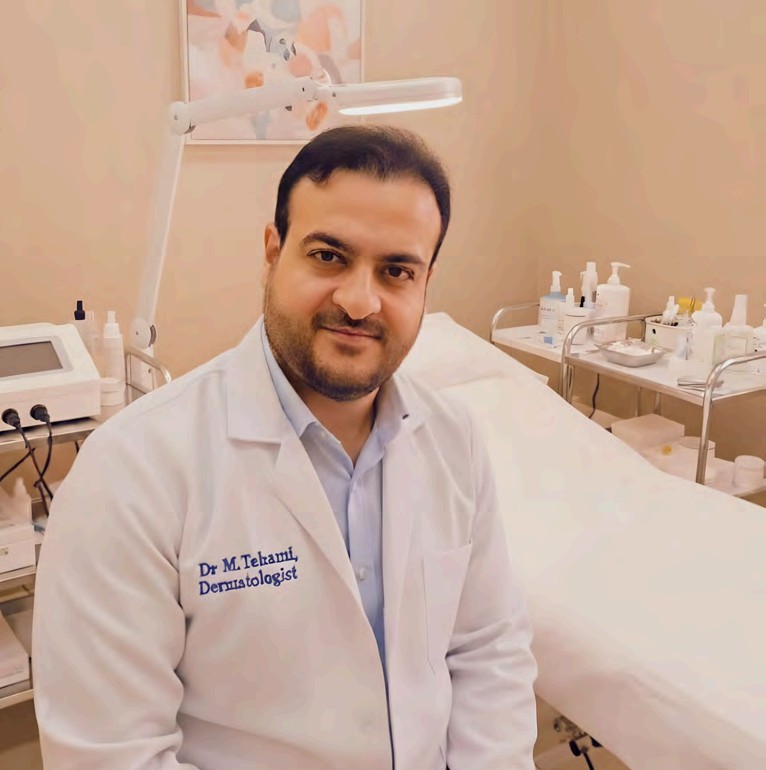
Dr. Mohammed Tehami is a dermatologist and pediatric dermatologist, Iranian Board certified in Dermatology, with more than 12 years of experience. He completed his dermatology specialisation at Mashhad University of Medical Sciences and a fellowship in pediatric dermatology at Tehran University of Medical Sciences, and he is a member of the European Academy of Dermatology and Venereology (EADV). He sees patients in Baghdad and Karbala and consults in Arabic, English and Farsi.
Since 2018 he has performed more than 500 botulinum toxin procedures, for cosmetic and medical reasons, and more than 70 autologous fat and nanofat procedures, for facial and body rejuvenation and for scars. These are his own clinic figures, updated in October 2026. They describe his experience; they are not a promise of any particular result.
He took part as an investigator in a clinical study of mechanical nanofat for the depressed scars left by cutaneous leishmaniasis (the "Baghdad boil"), a scar type common in Iraq.
Because he also treats children, one rule is fixed: cosmetic botulinum toxin is for adults only [1].
Treatments, and what each can do
- Botulinum toxin (Botox)
- Autologous fat transfer and nanofat
- Chemical peels
- Pigmentation and melasma
- Skin rejuvenation: microneedling, PRP and skin boosters
Botulinum toxin (Botox)
Botulinum toxin type A (commonly known as Botox) relaxes specific facial muscles, so frown lines, forehead lines and crow's feet look softer. In adults it is approved for these three areas [1][2]. You may notice a change after 2 to 3 days, the full effect shows at about 2 weeks, and results usually last about 3 to 4 months [3][4]. It softens lines temporarily; it does not remove them. It is also an approved treatment for heavy underarm sweating, while some other medical uses are off-label and are discussed case by case. Gummy smile caused by overactive upper lip muscles is an off-label cosmetic use with low-level evidence [24]. Dr. Tehami treats it with botulinum toxin in his practice, and, as with other Botox treatments, the result wears off.
Autologous fat transfer and nanofat
Fat transfer uses a small amount of your own fat to restore lost volume, for example in the cheeks or the backs of the hands. On average roughly 40 to 60% of the injected fat remains after a year, so a second session is sometimes needed [5][6]. Nanofat is fat processed so finely that it is used for skin texture and some scars rather than volume [7]. Its short-term results are encouraging, but long-term evidence is mixed [8]. A very rare but serious risk of any facial injection, including fat, is blockage of a blood vessel that can cause loss of vision [9].
Chemical peels
Superficial peels such as glycolic, mandelic or salicylic acid, or Jessner's solution, suit skin types III to V when the skin is prepared and the peel is started gently. Medium and deep peels carry a higher risk of pigment change and scarring in darker skin, so we use them rarely [10]. For melasma, peels are a second-line add-on after prescription creams [11].
Pigmentation and melasma
Melasma, marks after acne and sun spots are among the most common reasons people see a dermatologist here. During Iraq's long, intense summers the UV index in Baghdad reaches the "extreme" range [21][22]. Treatment starts with prescription creams, most often a triple combination cream used under supervision [13], and a tinted sunscreen with iron oxides [14]. Lasers are used rarely for melasma in darker skin because they can make it worse [15]. Velvety darkening of the neck or underarms can be linked to blood sugar problems, so we check for it rather than treating only the skin [20].
Skin rejuvenation: microneedling, PRP and skin boosters
Microneedling can improve the texture of acne scars over several sessions and generally suits darker skin [16]. Adding PRP may give somewhat better acne scar results than microneedling alone [17], but for general skin rejuvenation the research on PRP is mixed [18]. For mesotherapy, France's health authority found no positive clinical evidence [19], so we describe licensed skin boosters with modest expectations and do not offer unlicensed vitamin cocktails.
How we choose a treatment
Every plan starts with an assessment, not a menu.
- Diagnosis first: we check whether your concern is a skin condition that needs medical treatment, such as melasma, acne or acanthosis nigricans, before any cosmetic step [20].
- Your skin type: most of our patients have skin types III to V, which are more prone to dark marks after inflammation. That shapes the choice and strength of peels, lasers and needling [12].
- Realistic expectations: we explain what a treatment can and cannot do, how long it lasts and its main risks. Results vary between people, and we do not promise a result.
- Evidence and licence: we tell you when a use is off-label or when the evidence is limited, and we use only genuine, licensed products [23].
- Health and timing: pregnancy, breastfeeding, medicines and some medical conditions change what is safe, so we ask about them first [1].
- Adults only for cosmetic injections: cosmetic botulinum toxin is not given to anyone under 18 [1].
Frequently asked questions
Does Botox make wrinkles go away?
It softens expression lines temporarily, for about 3 to 4 months. It does not remove them permanently, and deep lines at rest improve only partly.
How long does Botox last?
Usually about 3 to 4 months. You may see a change after 2 to 3 days, and the full effect at about 2 weeks, when we review you.
How much of the injected fat stays?
On average roughly 40 to 60% of the injected volume remains after a year, so a second session is sometimes needed.
Is nanofat the same as fat transfer?
No. Fat transfer adds volume. Nanofat is processed so finely that it is used for skin texture and some scars, not volume, and its long-term evidence is mixed.
Are chemical peels safe for darker skin?
Superficial peels are generally safe for skin types III to V when the skin is prepared and the peel is started gently. Medium and deep peels carry a higher risk of dark marks and scarring, so we use them rarely.
Can melasma be cured permanently?
It can be controlled and greatly improved, but it is long-term and often returns, so maintenance treatment and a daily tinted sunscreen are part of the plan.
Can teenagers have cosmetic Botox or fillers?
No. Cosmetic botulinum toxin and fillers are for adults only. As a pediatric dermatologist, Dr. Tehami treats children's skin conditions, not cosmetic concerns with injections.
References
- [1] Allergan/AbbVie. BOTOX Cosmetic (onabotulinumtoxinA) Prescribing Information, including the boxed warning on distant spread of toxin effect. Source
- [2] US FDA approval history of BOTOX Cosmetic (onabotulinumtoxinA): frown lines 2002, crow's feet 2013, forehead lines 2017, platysma bands 2024. Drugs.com approval history and Healio report, 21 October 2024. Source
- [3] Glogau R, Kane M, Beddingfield F, Somogyi C. OnabotulinumtoxinA: a meta-analysis of duration of effect in the treatment of glabellar lines. Dermatol Surg. 2012;38(11):1794-1803. Source
- [4] NHS. Botox injections (cosmetic procedures). Source
- [5] Krastev TK, Beugels J, Hommes J, et al. Efficacy and safety of autologous fat transfer in facial reconstructive surgery: a systematic review and meta-analysis. JAMA Facial Plast Surg. 2018;20(5):351-360. Source
- [6] Gornitsky J, Viezel-Mathieu A, Alnaif N, Azzi AJ, Gilardino MS. A systematic review of the effectiveness and complications of fat grafting in the facial region. JPRAS Open. 2019;19:87-97. Source
- [7] Tonnard P, Verpaele A, Peeters G, Hamdi M, Cornelissen M, Declercq H. Nanofat grafting: basic research and clinical applications. Plast Reconstr Surg. 2013;132(4):1017-1026. Source
- [8] Al-sabri G, Alavi S, Alkaabi S, Maningky M, Forouzanfar T, Helder M. The effectiveness of nanofat in the management of skin scars: a systematic review. Aesthet Surg J Open Forum. 2025;7:ojaf080. Source
- [9] Lazzeri D, Agostini T, Figus M, Nardi M, Pantaloni M, Lazzeri S. Blindness following cosmetic injections of the face. Plast Reconstr Surg. 2012;129(4):995-1012. Source
- [10] Desai M, Gill J, Luke J. Cosmetic procedures in patients with skin of color: clinical pearls and pitfalls. J Clin Aesthet Dermatol. 2023;16(3):37-40. Source
- [11] Sarkar R, Arsiwala S, Dubey N, et al. Chemical peels in melasma: a review with consensus recommendations by Indian pigmentary expert group. Indian J Dermatol. 2017;62(6):578-584. Source
- [12] Davis EC, Callender VD. Postinflammatory hyperpigmentation: a review of the epidemiology, clinical features, and treatment options in skin of color. J Clin Aesthet Dermatol. 2010;3(7):20-31. Source
- [13] Rajaratnam R, Halpern J, Salim A, Emmett C. Interventions for melasma. Cochrane Database Syst Rev. 2010;(7):CD003583. Source
- [14] Castanedo-Cazares JP, Hernandez-Blanco D, Carlos-Ortega B, Fuentes-Ahumada C, Torres-Alvarez B. Near-visible light and UV photoprotection in the treatment of melasma: a double-blind randomized trial. Photodermatol Photoimmunol Photomed. 2014;30(1):35-42. Source
- [15] Trivedi MK, Yang FC, Cho BK. A review of laser and light therapy in melasma. Int J Womens Dermatol. 2017;3(1):11-20. Source
- [16] Sitohang IBS, Sirait SAP, Suryanegara J. Microneedling in the treatment of atrophic scars: a systematic review of randomised controlled trials. Int Wound J. 2021;18(5):577-585. Source
- [17] Kang C, Lu D. Combined effect of microneedling and platelet-rich plasma for the treatment of acne scars: a meta-analysis. Front Med (Lausanne). 2022;8:788754. Source
- [18] Cruciani M, Masiello F, Pati I, Pupella S, De Angelis V. Platelet rich plasma for facial rejuvenation: an overview of systematic reviews. Blood Transfus. 2024;22(5):429-440. Source
- [19] Haute Autorite de Sante (HAS, France). Assessment of the risks associated with aesthetic mesotherapy practices. June 2014. Source
- [20] Hughes EK, Brady MF, Rawla P. Acanthosis nigricans. In: StatPearls. StatPearls Publishing; updated 11 August 2023. Source
- [21] Alwan A, Hameed A, Hamad N. Analyzing of UV index with the time variation for Baghdad. Iraqi J Ind Res. 2021;8(1):50-54. Source
- [22] World Health Organization, WMO, UNEP, ICNIRP. Global solar UV index: a practical guide. Geneva: WHO; 2002. Source
- [23] US FDA. Counterfeit version of Botox found in multiple states. Drug Safety and Availability alert, 17 April 2024. Source
- [24] Rojo-Sanchis C, Montiel-Company JM, Tarazona-Alvarez B, et al. Non-surgical management of the gingival smile with botulinum toxin A: a systematic review and meta-analysis. J Clin Med. 2023;12(4):1433. Source
This content is general medical education and does not replace a personal consultation. Results vary from person to person.
Start with an assessment
Book a consultation to discuss your skin and your goals, in person in Baghdad or Karbala, or by video.