Melasma and Pigmentation Treatment in Baghdad and Karbala
Melasma and other dark patches can be controlled and greatly improved. Treatment starts with an accurate assessment, prescription creams and the right sunscreen, and continues with maintenance because pigmentation often returns.
Melasma, dark marks after acne and sun spots are among the most common reasons people see a dermatologist in our region. During Iraq's long, intense summers the UV index in Baghdad reaches the "extreme" range [3][4], and sunlight is one of the main triggers of melasma [1]. Melasma is a long-term condition. It can be controlled and greatly improved, but it often returns, so a good plan includes maintenance from the start [1]. This guide explains the causes, how we assess pigmentation, which treatments come first and which are add-ons.
Key points
- Melasma is long-term: it can be controlled and greatly improved, but it often returns [1]
- Visible light, not only UV, darkens pigmentation in darker skin, so a tinted sunscreen with iron oxides is part of treatment [2][15][16]
- First-line treatment is prescription creams, most often a triple combination cream used for a limited, supervised period [8][9]
- Tranexamic acid tablets help some patients but are off-label for melasma and need screening for clotting risk first [11][13]
- Peels and microneedling are add-ons. Lasers are used rarely because they can make pigmentation worse in darker skin [17][18][19]
- Dark, velvety skin on the neck or underarms can be linked to blood sugar problems and needs a medical check [7]
Why pigmentation is so common here
A year of measurements in Baghdad recorded a UV index of 11 in summer, which the World Health Organization classes as "extreme", and about 1 in winter [3][4]. Most of our patients have skin types III to V, and darker skin is more likely to develop dark marks after inflammation or irritation [5].
It is not only ultraviolet light. In skin types IV to VI, visible light caused darker and longer-lasting pigmentation than long-wave UVA in a laboratory study, while it caused none in fair skin [2]. That is why ordinary sunscreen alone often fails to control melasma in darker skin.
The common causes of dark patches
Different kinds of pigmentation need different treatment, so the first step is naming the cause correctly.
- Melasma (الكلف): brown patches on the face. Sunlight, hormones (pregnancy and hormonal contraception) and genetics are the main factors [1], and heat can make it worse. It tends to return after treatment [1].
- Dark marks after acne or irritation (post-inflammatory hyperpigmentation): more frequent and more severe in darker skin, including people of Middle Eastern descent [5]. The first step is to treat the cause, such as active acne, then use sunscreen and lightening creams [5].
- Freckles and sun spots: caused by sun exposure [6]. In darker skin, laser for these spots can leave dark marks, so a test patch and conservative settings are needed [5].
- Darkening around the mouth: the causes vary, including irritation or contact allergy, lip licking, friction, marks after inflammation, some medicines and acanthosis nigricans. We look for the cause first rather than promising one fix.
- Dark underarms or neck: velvety darkening of the neck, armpits or groin (acanthosis nigricans) is most often linked to insulin resistance, excess weight and type 2 diabetes. Rarely, a sudden, widespread onset can be a sign of an internal disease, including cancer [7]. Friction, shaving or deodorant irritation and marks after inflammation are other causes. This is not only a cosmetic issue.
How we assess your pigmentation
We ask when the patches started, about pregnancy, hormonal contraception, sun exposure, acne and the products and medicines you use. We examine the pattern and decide whether the pigment sits mainly near the surface (epidermal) or deeper (dermal), because that changes which treatments are safe: peels, for example, are better avoided in deeper melasma [17].
If there is velvety darkening of the neck or underarms, we check for insulin resistance with your history, weight and a blood test such as fasting glucose or HbA1c [7]. Before tranexamic acid tablets we screen for any history or risk of blood clots [13]. We take photos so progress can be judged fairly over months, not days.
First-line treatment: prescription creams
Treatment usually starts with prescription creams. The most studied is a triple combination cream that contains hydroquinone 4%, tretinoin 0.05% and a mild steroid (fluocinolone 0.01%). In a Cochrane review it was more effective than hydroquinone alone [8], and a 2025 international consensus calls hydroquinone-based triple combination cream the gold standard, together with broad-spectrum sun protection [9]. It is used for a limited, supervised period, because the steroid can thin the skin and long use of hydroquinone can cause a lasting blue-grey discolouration called exogenous ochronosis [8][9].
That is why hydroquinone should be used under a doctor's supervision, not bought and used for months on your own. Alternatives include hydroquinone alone, azelaic acid 20% and tretinoin [10]. Cysteamine cream is another option: in a meta-analysis of 8 studies it worked better than placebo but not better than other melasma treatments, and irritation is common [14].
Tranexamic acid: helpful for some, with screening
Tranexamic acid tablets can help some patients with moderate to severe melasma. In a randomised trial in 44 women, three months of treatment reduced melasma severity by about half, compared with 18% in the placebo group [11], and a meta-analysis of 21 trials also found reduced severity [12]. Melasma often returns after the tablets are stopped.
This is an off-label use, and the tablets are not suitable for everyone. The tablet label lists active or past blood clots (including deep vein thrombosis, pulmonary embolism, stroke and blockage of a vessel in the eye), an increased tendency to clot, and use together with combined hormonal contraception as reasons not to take them [13]. So they are prescription only, after careful screening, and never something to take on your own. Tranexamic acid can also be applied to the skin or given in tiny injections, often with microneedling; the evidence for these forms is weaker. A 2022 review of 33 studies of injections into the skin (mesotherapy) for melasma, most of them with tranexamic acid, concluded they can be an alternative or add-on treatment, but larger studies are still needed [20].
Sunscreen that works for melasma: tinted, with iron oxides
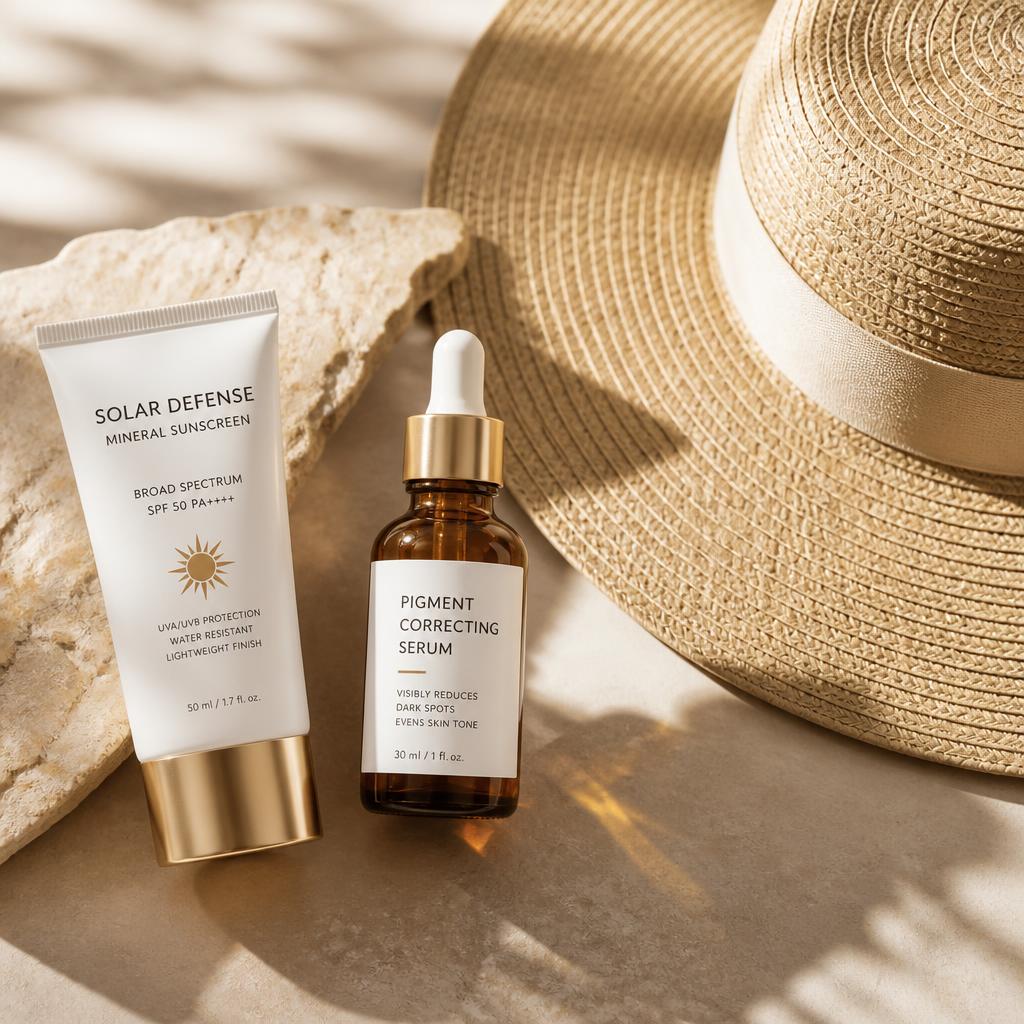
Because visible light darkens melasma in darker skin [2], we recommend a tinted sunscreen containing iron oxides, reapplied during the day. In a randomised trial of 68 patients all using 4% hydroquinone, a sunscreen that also blocked visible light gave about 15% greater improvement in melasma severity than a UV-only sunscreen over 8 weeks [15]. In another trial, an iron oxide tinted sunscreen reduced melasma relapses through spring and summer compared with the same UV filters without iron oxide [16].
A hat and shade help too. Sunscreen is not an optional extra: without it, every other treatment loses ground during Iraq's long, intense summers.
Peels, microneedling and lasers: add-ons, used with care
Gentle chemical peels are second-line for melasma. They mainly help the surface (epidermal) type, after a few weeks of preparing the skin with creams, and are better avoided in deeper melasma because they can cause scarring and patchy colour [17].
Microneedling may be added to creams for stubborn melasma: in a meta-analysis of 12 studies, adding it to topical treatment gave extra improvement at 8 and 12 to 16 weeks, but follow-up was short and relapse was not studied [18].
Laser for pigmentation (ليزر التصبغات) needs particular caution. A review of laser and light treatments in melasma found a high rate of recurrence and a risk of darker or lighter marks afterwards, and ablative fractional lasers carry a very high risk of pigment change [19]. We use lasers rarely for melasma in darker skin, at low energy and only for selected cases that have not responded to other treatment, because they can make pigmentation worse.
Relapse and long-term maintenance
Relapse after improvement is common in melasma [1], especially with sun exposure, heat or hormonal changes. Most people need ongoing maintenance after the first course: daily tinted sunscreen, a maintenance cream as advised, and a plan before each summer. If pigmentation returns, starting treatment early usually brings it back under control faster.
Frequently asked questions
Can melasma be cured permanently?
Melasma can be controlled and greatly improved, but it is a long-term condition and often returns, especially with sun, heat or hormonal changes. That is why maintenance treatment and daily tinted sunscreen are part of the plan.
Is laser the best treatment for pigmentation?
Not for melasma in darker skin. Lasers can help some sun spots, but in melasma they have a high recurrence rate and can make pigmentation worse. We use them rarely, at low energy, for selected cases that have not responded to creams.
Is hydroquinone safe?
Used as prescribed for a limited period it is an effective first-line treatment. Long, unsupervised use can cause a lasting blue-grey discolouration, so it should be used under a doctor's supervision.
Can I take tranexamic acid tablets on my own?
No. They are off-label for melasma and are not suitable for people with a history or risk of blood clots or those taking combined hormonal contraception. They need a prescription after careful screening.
Which sunscreen is best for melasma?
A broad-spectrum sunscreen that is tinted and contains iron oxides, because visible light can darken melasma in darker skin. Reapply it during the day and add a hat and shade.
Why are my underarms dark?
Friction, shaving or deodorant irritation can cause it, but velvety darkening of the underarms or neck is often linked to insulin resistance and needs a medical check, including a blood sugar test when appropriate.
References and sources
- [1] Sarkar R, Gokhale N, Godse K, et al. Medical management of melasma: a review with consensus recommendations by Indian pigmentary expert group. Indian J Dermatol. 2017;62(6):558-577.
- [2] Mahmoud BH, Ruvolo E, Hexsel CL, et al. Impact of long-wavelength UVA and visible light on melanocompetent skin. J Invest Dermatol. 2010;130(8):2092-2097.
- [3] Alwan A, Hameed A, Hamad N. Analyzing of UV index with the time variation for Baghdad. Iraqi J Ind Res. 2021;8(1):50-54.
- [4] World Health Organization, WMO, UNEP, ICNIRP. Global solar UV index: a practical guide. Geneva: WHO; 2002.
- [5] Davis EC, Callender VD. Postinflammatory hyperpigmentation: a review of the epidemiology, clinical features, and treatment options in skin of color. J Clin Aesthet Dermatol. 2010;3(7):20-31.
- [6] Fisher GJ, Kang S, Varani J, et al. Mechanisms of photoaging and chronological skin aging. Arch Dermatol. 2002;138(11):1462-1470.
- [7] Hughes EK, Brady MF, Rawla P. Acanthosis nigricans. In: StatPearls. StatPearls Publishing; updated 11 August 2023.
- [8] Rajaratnam R, Halpern J, Salim A, Emmett C. Interventions for melasma. Cochrane Database Syst Rev. 2010;(7):CD003583.
- [9] Sarkar R, Desai SR, Sinha S, Dogra S, et al.; Pigmentary Disorders Society. Delphi consensus on melasma management by international experts and pigmentary disorders society. J Eur Acad Dermatol Venereol. 2026;40(4):680-692 (epub 2025).
- [10] Rendon M, Berneburg M, Arellano I, Picardo M. Treatment of melasma. J Am Acad Dermatol. 2006;54(5 Suppl 2):S272-S281.
- [11] Del Rosario E, Florez-Pollack S, Zapata L Jr, et al. Randomized, placebo-controlled, double-blind study of oral tranexamic acid in the treatment of moderate-to-severe melasma. J Am Acad Dermatol. 2018;78(2):363-369.
- [12] Zhang L, Tan WQ, Fang QQ, et al. Tranexamic acid for adults with melasma: a systematic review and meta-analysis. Biomed Res Int. 2018;2018:1683414.
- [13] Lysteda (tranexamic acid) tablets, US Prescribing Information, NDA 022430: contraindications.
- [14] Wu BQ, Wang YJ, Chang CC, Juang TY, Huang YH, Hsu YC. Clinical efficacy of cysteamine application for melasma: a meta-analysis. J Clin Med. 2024;13(23):7483.
- [15] Castanedo-Cazares JP, Hernandez-Blanco D, Carlos-Ortega B, Fuentes-Ahumada C, Torres-Alvarez B. Near-visible light and UV photoprotection in the treatment of melasma: a double-blind randomized trial. Photodermatol Photoimmunol Photomed. 2014;30(1):35-42.
- [16] Boukari F, Jourdan E, Fontas E, et al. Prevention of melasma relapses with sunscreen combining protection against UV and short wavelengths of visible light: a prospective randomized comparative trial. J Am Acad Dermatol. 2015;72(1):189-190.e1.
- [17] Sarkar R, Arsiwala S, Dubey N, et al. Chemical peels in melasma: a review with consensus recommendations by Indian pigmentary expert group. Indian J Dermatol. 2017;62(6):578-584.
- [18] Bailey AJM, Li HOY, Tan MG, Cheng W, Dover JS. Microneedling as an adjuvant to topical therapies for melasma: a systematic review and meta-analysis. J Am Acad Dermatol. 2022;86(4):797-810.
- [19] Trivedi MK, Yang FC, Cho BK. A review of laser and light therapy in melasma. Int J Womens Dermatol. 2017;3(1):11-20.
- [20] Khalili M, Amiri R, Iranmanesh B, Zartab H, Aflatoonian M. Safety and efficacy of mesotherapy in the treatment of melasma: a review article. J Cosmet Dermatol. 2022;21(1):118-129.
Need advice for your own skin?
Book a video consultation from anywhere in Iraq, or a clinic visit in Baghdad or Karbala.