Fractional laser resurfacing: scars, sun damage and texture in skin of colour
Fractional lasers treat a fraction of the skin at a time, leaving untreated bridges that speed healing. That principle is what makes deep remodelling possible with acceptable downtime.
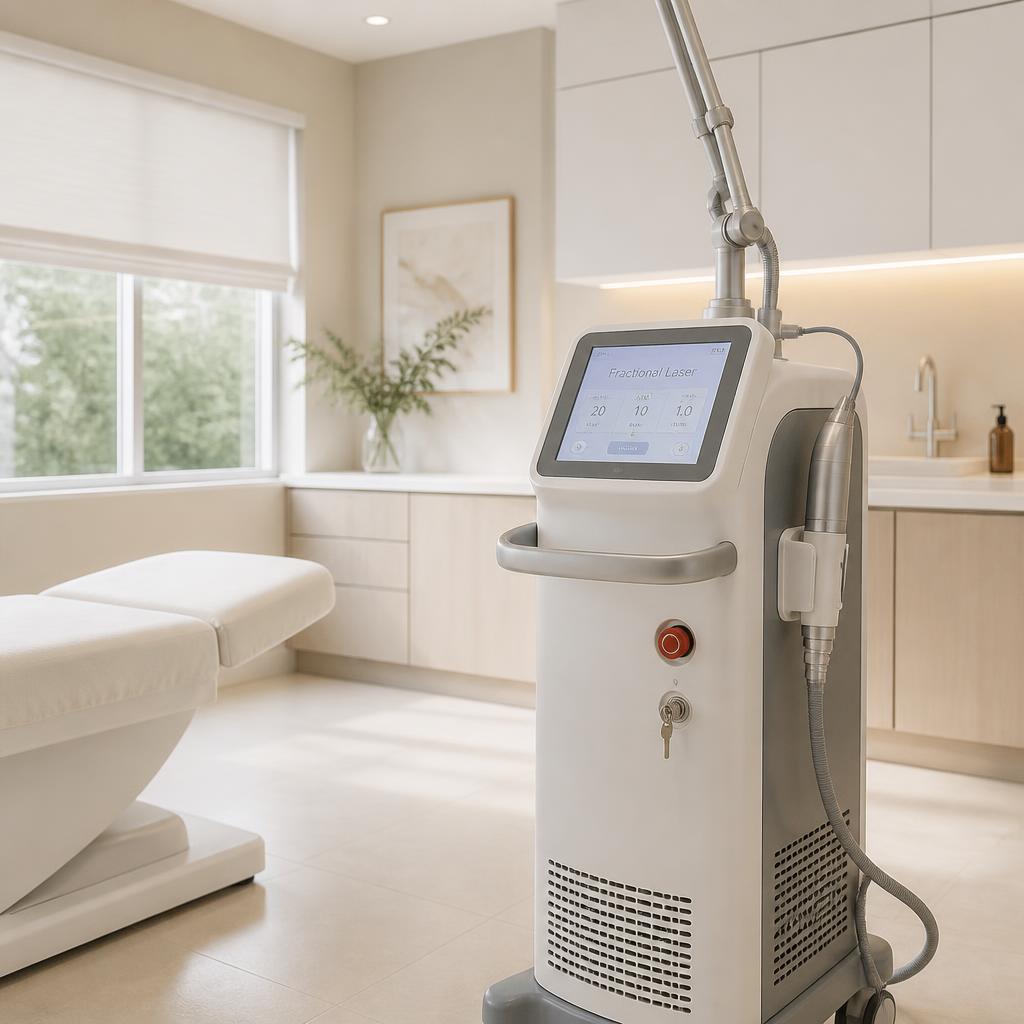
Fractional photothermolysis was introduced in 2004 and changed resurfacing permanently. Instead of removing the whole surface, the laser creates columns of thermal injury separated by untreated skin, so healing is driven from the surrounding intact tissue [1]. This allows deep dermal remodelling with a fraction of the risk of full field ablative resurfacing, which matters enormously in medium and darker skin.
Key points
- Non ablative fractional lasers heat the dermis without removing the surface, giving less downtime and lower pigment risk
- Ablative fractional lasers such as CO2 and erbium remove tissue columns and give stronger scar improvement
- Three to five sessions are usual for acne scarring, spaced six to eight weeks apart
- Post inflammatory hyperpigmentation is the main risk in phototypes four and above, and is managed with conservative density and priming
- Improvement continues for six months after the final session
Ablative versus non ablative
Non ablative fractional devices, typically 1540 or 1550 nanometre erbium glass lasers, coagulate columns of dermis while the epidermis stays intact. Recovery is two to three days of redness and roughness, and multiple sessions are needed. This is the safer starting point in brown skin.
Ablative fractional devices, usually CO2 at 10600 nanometres or erbium YAG at 2940 nanometres, vaporise columns of tissue. They deliver greater collagen remodelling per session and better results in deep scarring, but with five to seven days of visible healing, several weeks of pinkness and a genuine risk of pigment change if aftercare is poor [1].
What fractional laser treats
The strongest indication is atrophic acne scarring, where controlled studies show meaningful improvement across scar types, with boxcar and rolling scars responding better than ice pick [2]. It is also used for surgical and traumatic scars, burn scars, photoageing, actinic keratoses with ablative settings, striae, and rhinophyma.
A well planned scar programme rarely uses laser alone. Subcision for tethered rolling scars, TCA CROSS for ice pick scars and filler for volume deficit are combined with laser in sequence, because each scar morphology has a different mechanical problem.
- Boxcar and rolling acne scars: fractional laser, often after subcision
- Ice pick scars: TCA CROSS first, laser later
- Surgical and burn scars: fractional ablative from three months after healing
- Photoageing and fine lines: non ablative fractional over a course
Treating darker skin safely
Phototypes four to six carry a higher risk of post inflammatory hyperpigmentation, reported in a substantial minority of patients after aggressive fractional ablative treatment. Risk is reduced by lowering treatment density rather than energy, increasing intervals between sessions, priming with a pigment inhibitor before treatment, and treating any inflammation immediately [2].
A test patch in front of the ear or under the jaw four weeks before a full treatment is a sensible precaution for a first laser in darker skin, and it costs very little compared with managing a full face of pigmentation.
The procedure and recovery
Topical anaesthetic is applied for an hour, sometimes with a nerve block for ablative treatment. The session takes twenty to forty minutes. Immediately afterwards the skin feels hot and looks red and swollen, similar to strong sunburn.
Ablative recovery follows a predictable path: swelling and oozing on days one and two, bronzing and fine crusting on days three to five, then peeling. Petrolatum or a bland occlusive ointment, frequent gentle cleansing and absolute sun avoidance are the core of aftercare. Antiviral prophylaxis is given to anyone with a history of cold sores.
Risks
Beyond pigmentation, risks include prolonged erythema, infection with bacteria, herpes or candida, acneiform eruption, milia and, rarely, scarring where energy or density was excessive or where healing was disturbed by infection or picking.
Absolute contraindications include active infection at the site, isotretinoin within the preceding six months in most protocols, active connective tissue disease affecting healing, and unrealistic expectations. Recent tanning is a temporary contraindication and matters throughout the Iraqi summer.
Frequently asked questions
How much improvement can I expect in acne scars?
A realistic target for a combined programme is fifty to seventy percent improvement in scar depth and visibility, not complete erasure. Photographs taken in standard lighting are the only fair way to judge.
How long between sessions?
Six to eight weeks for non ablative and eight to twelve weeks for ablative, because remodelling continues long after the surface has healed.
Which season is best?
Autumn and winter, so that the healing period and the following weeks avoid intense sun. Summer treatment is possible but requires real discipline with sun avoidance.
References
- [1] Manstein D, Herron GS, Sink RK, et al. Fractional photothermolysis: a new concept for cutaneous remodeling using microscopic patterns of thermal injury. Lasers in Surgery and Medicine. Source
- [2] Alexis AF. Lasers and light based therapies in ethnic skin: treatment options and recommendations for Fitzpatrick skin types V and VI. British Journal of Dermatology. Source
- [3] American Academy of Dermatology clinical guidelines. Source
This content is general medical education and does not replace a personal consultation. Any prescription must be coordinated with your local doctor.
Is this procedure right for you?
Book a video consultation to discuss your case, or a clinic visit in Baghdad or Karbala.