Laser tattoo removal: how ink is cleared and what determines the number of sessions
Tattoo removal is a series of controlled photomechanical events, not an erasure. Ink colour, depth, age and your skin type decide how many sessions it takes.
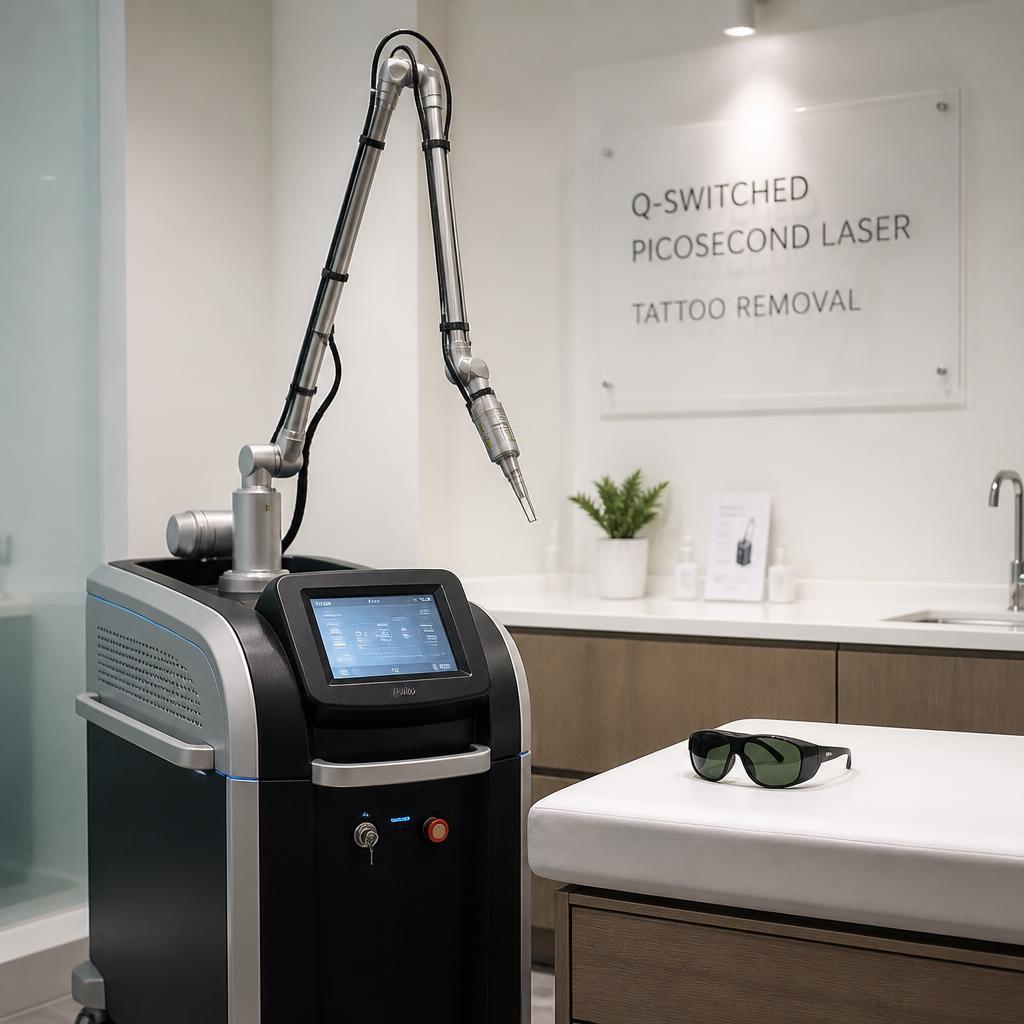
Tattoo ink sits in dermal macrophages as particles too large for the body to clear. Q switched and picosecond lasers deliver energy in nanosecond or picosecond pulses, producing a photoacoustic shock that fragments the particles into pieces small enough to be removed by the lymphatic system over the following weeks [1].
Key points
- Black ink responds best and is treated with 1064 nanometre light, which is also the safest wavelength for darker skin
- Red, green and blue inks need different wavelengths and clear less predictably
- Sessions are spaced six to eight weeks apart to allow clearance
- Amateur tattoos often clear in four to six sessions, professional tattoos may need ten or more
- Complete clearance cannot be guaranteed for any tattoo
Wavelength and colour
Each ink colour absorbs specific wavelengths. The 1064 nanometre Nd:YAG targets black and dark blue and passes over epidermal melanin relatively safely, making it the primary choice in Fitzpatrick types four to six. The 532 nanometre wavelength targets red and orange. Ruby at 694 and alexandrite at 755 nanometres target green and blue, but both are absorbed strongly by melanin and carry higher pigment risk in brown skin [2].
Picosecond devices deliver shorter pulses and generally achieve clearance in fewer sessions, particularly for stubborn colours, though they are not universally superior and are less widely available.
How many sessions to expect
The Kirby Desai scale estimates session numbers from skin type, tattoo location, ink colour, amount of ink, scarring and layering. Distal sites such as the ankle clear more slowly than the trunk because of poorer lymphatic drainage.
A realistic expectation is four to six sessions for an amateur single colour tattoo and eight to fifteen for a dense professional multicolour piece. Some inks, particularly white, flesh tones and certain greens, may not clear at all and can paradoxically darken through chemical reduction of the pigment.
- Black amateur tattoo: often four to six sessions
- Professional multicolour: eight to fifteen sessions or more
- Interval: six to eight weeks minimum
- Cosmetic tattoos containing iron or titanium oxide can darken immediately, so test patch first
Risks, especially in brown skin
Hypopigmentation and hyperpigmentation are the main risks in darker skin and are reduced by using 1064 nanometre light, conservative fluence, adequate cooling and longer intervals. Blistering, crusting, textural change and, rarely, scarring can occur.
Allergic reactions to fragmented ink, most often red, can produce an itchy inflammatory response. Immediate darkening of cosmetic tattoos is a recognised phenomenon and is why a small test spot is done first on eyebrow or lip pigment [2].
The session and aftercare
A topical anaesthetic or injected local anaesthetic is used. The sensation is repeated hot snapping. The treated area whitens immediately, a normal transient effect from gas formation, and then swells and may blister.
Keep the area covered with a bland ointment and a dressing for several days, do not pick crusts, avoid swimming pools until healed and protect from sun for at least a month between sessions.
Frequently asked questions
Will the tattoo disappear completely?
Often it fades to a faint shadow rather than vanishing entirely. Complete clearance is common for simple black tattoos and much less predictable for dense multicolour work.
Is removal more difficult on dark skin?
It requires more caution and usually more sessions at lower energy, because the laser must distinguish ink from surrounding melanin. It is entirely feasible with the right wavelength and settings.
Can a tattoo be removed before a cover up?
Yes, and partial fading over three to four sessions is often enough for a tattoo artist to work over it, which is quicker and cheaper than full removal.
References
- [1] Kent KM, Graber EM. Laser tattoo removal: a review. Dermatologic Surgery. Source
- [2] Bernstein EF. Laser treatment of tattoos. Clinics in Dermatology. Source
- [3] British Association of Dermatologists patient information. Source
This content is general medical education and does not replace a personal consultation. Any prescription must be coordinated with your local doctor.
Is this procedure right for you?
Book a video consultation to discuss your case, or a clinic visit in Baghdad or Karbala.