Cryotherapy: freezing warts, keratoses and small skin lesions
Liquid nitrogen at minus one hundred and ninety six degrees destroys tissue by ice crystal formation. Simple, quick and effective, with one important caveat in darker skin.
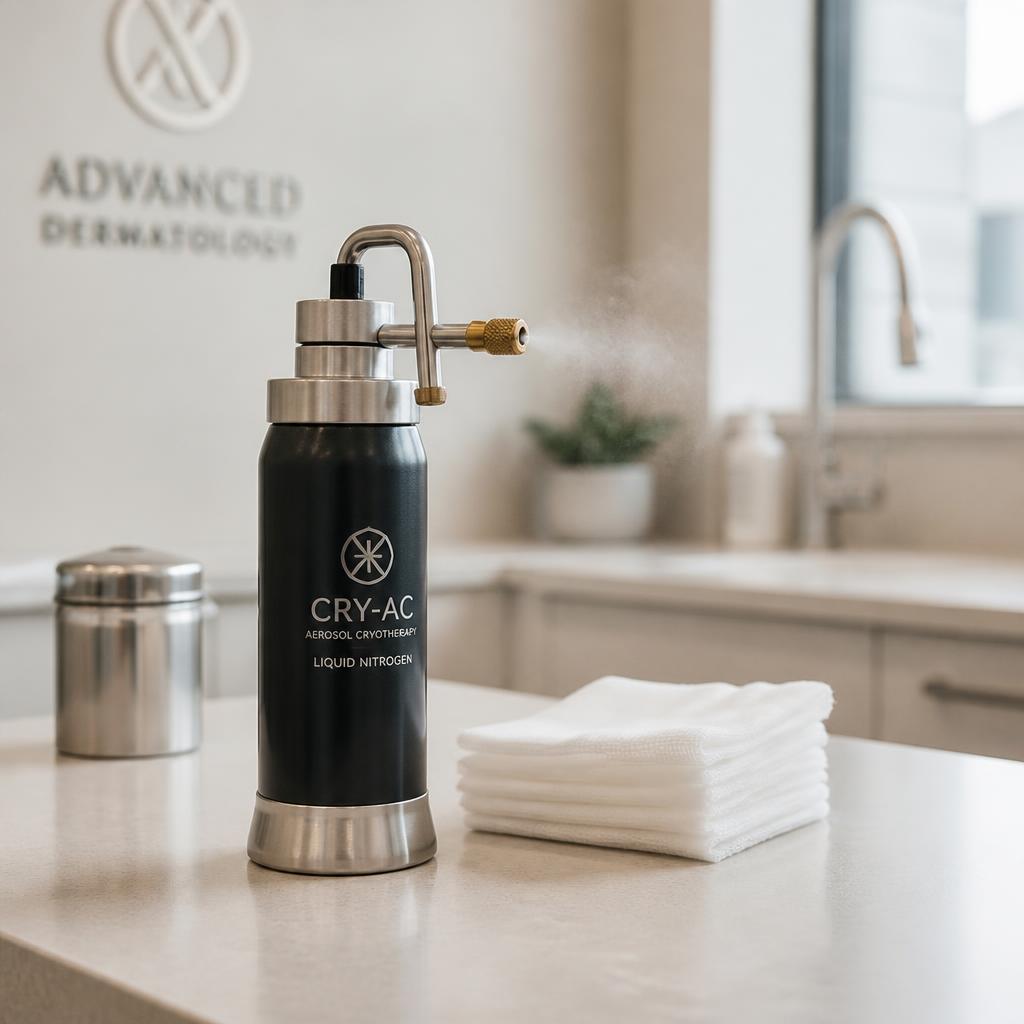
Cryotherapy uses liquid nitrogen to freeze tissue rapidly. Intracellular ice crystals rupture cell membranes, and the subsequent vascular stasis completes the destruction. It is one of the most widely used procedures in dermatology because it is fast, needs no anaesthesia in most cases and requires no sutures [1].
Key points
- Used for viral warts, seborrhoeic keratoses, actinic keratoses, molluscum and small benign lesions
- Never used on a lesion that could be a skin cancer without a diagnosis first
- Two freeze thaw cycles are more effective than one for warts
- Permanent white marks are a real risk in Fitzpatrick types four to six
- Cochrane evidence shows cryotherapy and salicylic acid are broadly comparable for common warts
What responds well
Common and plantar viral warts, seborrhoeic keratoses, actinic keratoses, molluscum contagiosum, small skin tags, sebaceous hyperplasia and some solar lentigines are routine indications. Freeze time is matched to the lesion: a few seconds for a thin keratosis, longer with a wider margin for a thick plantar wart.
A Cochrane review of treatments for cutaneous warts found no clear overall superiority of cryotherapy over topical salicylic acid, with both offering moderate cure rates and cryotherapy performing relatively better on hand warts [2]. Combining both is common practice.
- Viral warts: two freeze thaw cycles, repeated every two to three weeks
- Seborrhoeic keratoses: a single short freeze usually suffices
- Actinic keratoses: brief freeze, often over multiple lesions in a session
- Molluscum in children: used selectively, since most resolve spontaneously
What must not be frozen
Any pigmented lesion that has changed, any persistent ulcerated or bleeding lesion, and any lesion where basal cell carcinoma, squamous cell carcinoma or melanoma is possible should be examined and biopsied rather than frozen. Freezing an unrecognised skin cancer delays diagnosis and can allow deeper growth beneath apparently healed skin.
This is the single most important safety rule in cryotherapy and is the reason dermoscopy is used before treating anything that is not clearly benign.
Pigment change in brown skin
Melanocytes are more sensitive to cold than keratinocytes, so freezing frequently leaves a pale mark. In lighter skin this often goes unnoticed, but in Fitzpatrick types four to six it can leave a conspicuous white spot that may be permanent, and sometimes a ring of hyperpigmentation around it.
For this reason cryotherapy is used cautiously on visible areas in darker skin, with shorter freeze times, and alternatives such as curettage, electrosurgery or topical treatment are discussed for facial lesions.
Aftercare
Stinging lasts a few minutes. Redness and swelling follow, and a blister, sometimes blood filled, may form within twenty four hours. This is expected. Leave the blister intact if possible, keep the area clean and dry, and apply an antiseptic ointment if it breaks.
Healing takes one to three weeks depending on site, with plantar lesions slowest. Warts usually need three to six treatments spaced two to three weeks apart.
Frequently asked questions
Does it hurt?
There is a sharp burning sting during freezing and for a few minutes afterwards, then soreness for a day or two. Anaesthesia is rarely needed.
How many sessions for a wart?
Three to six sessions every two to three weeks is typical. Warts that have not responded after six treatments usually need a different approach.
Will it leave a mark?
It can leave a pale patch, particularly on darker skin. This is why lesion selection and freeze time are chosen carefully, and why the face is treated conservatively.
References
- [1] Andrews MD. Cryosurgery for common skin conditions. American Family Physician. Source
- [2] Kwok CS, Gibbs S, Bennett C, Holland R, Abbott R. Topical treatments for cutaneous warts. Cochrane Database of Systematic Reviews. Source
- [3] Cochrane Library. Source
This content is general medical education and does not replace a personal consultation. Any prescription must be coordinated with your local doctor.
Is this procedure right for you?
Book a video consultation to discuss your case, or a clinic visit in Baghdad or Karbala.