Excimer targeted phototherapy for localised vitiligo and psoriasis
Excimer light delivers a high dose to the patch and nothing to the skin around it, which makes it the efficient choice when disease is limited.
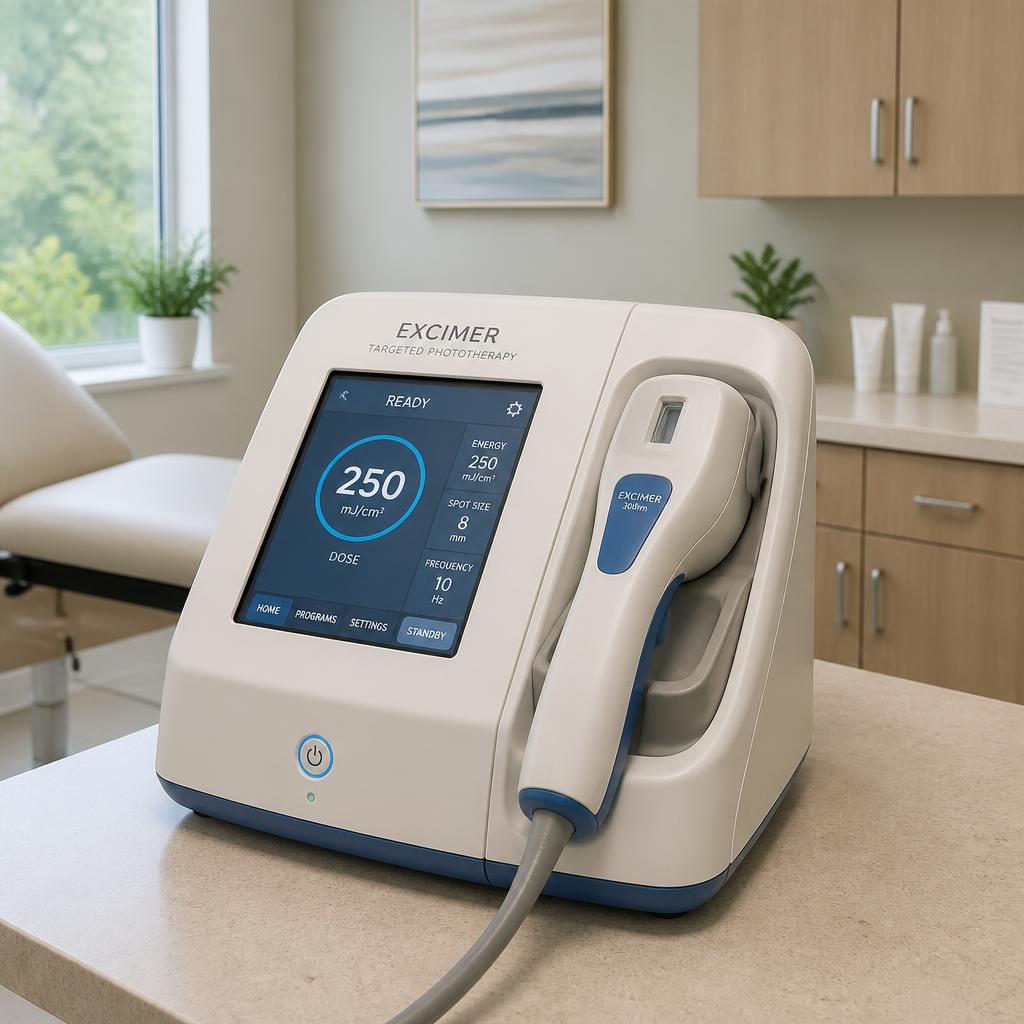
The excimer laser and excimer lamp emit at 308 nanometres, close to the peak of narrowband UVB but delivered through a small handpiece. Because only affected skin is exposed, higher doses can be used safely, responses come faster, and the cumulative ultraviolet load on healthy skin is far lower [1].
Key points
- Ideal when disease covers less than roughly ten percent of the body surface
- Faster response than whole body cabinets because higher doses are tolerated
- Especially useful for facial vitiligo, scalp psoriasis and elbows and knees
- Sessions are typically twice weekly, taking only minutes
- Combining with topical calcineurin inhibitors improves vitiligo repigmentation
Where it is the better choice
A patient with two vitiligo patches on the face does not need whole body ultraviolet exposure three times a week. Targeted phototherapy treats the patches only, protects surrounding skin from unnecessary tanning that would increase contrast, and takes a few minutes per visit.
Localised psoriasis on the elbows, knees or scalp, and small plaques of eczema or lichen planus, are handled the same way. In children it is often more practical than a cabinet because sessions are short.
Results in vitiligo
Studies of excimer treatment in vitiligo report repigmentation in a majority of treated facial lesions when treatment continues long enough, with the face and neck responding best and acral sites poorly [2]. Repigmentation typically becomes visible after twelve to twenty four sessions, and treatment continues while progress is being made.
Combination with topical tacrolimus is common practice and produces better repigmentation than light alone in published comparisons.
- Face and neck: best response
- Trunk and proximal limbs: moderate response
- Hands, feet, lips: limited response, alternative approaches discussed
- Segmental vitiligo: often better treated surgically once stable
Practical details
A starting dose is determined by site and skin type, and increased gradually. Sessions are usually twice weekly, and there is no need for the daily disruption of a cabinet appointment. Treatment is stopped if no response is seen after a reasonable trial, generally three months in vitiligo.
Mild redness or a slight blister at the treated site indicates the dose was too high and is used to adjust subsequent sessions.
Limitations
It is impractical for extensive disease, where a cabinet is faster and more economical. Availability is limited outside specialist centres, and cost per session can be higher.
It does not stop new vitiligo patches appearing, so active spreading disease may need systemic treatment to halt progression before phototherapy is used to repigment.
Frequently asked questions
How long is a session?
Usually only a few minutes, since only the affected areas are exposed.
How soon will pigment return?
Most patients who respond see the first small pigmented dots after twelve to twenty four sessions. Judge at three months, not three weeks.
Is it safer than a whole body cabinet?
The total ultraviolet exposure to healthy skin is much lower, which is a genuine advantage, though the dose to the treated patch is higher.
References
- [1] Mehraban S, Feily A. 308 nm excimer laser in dermatology. Journal of Lasers in Medical Sciences. Source
- [2] Taieb A, Picardo M, et al. Guidelines for the management of vitiligo. British Journal of Dermatology. Source
This content is general medical education and does not replace a personal consultation. Any prescription must be coordinated with your local doctor.
Is this procedure right for you?
Book a video consultation to discuss your case, or a clinic visit in Baghdad or Karbala.