Intense pulsed light (IPL): redness, sun spots and hair, and its limits in brown skin
IPL is a broad spectrum light source rather than a laser. That flexibility is its strength for redness and sun spots, and also the reason it needs careful settings in darker skin.
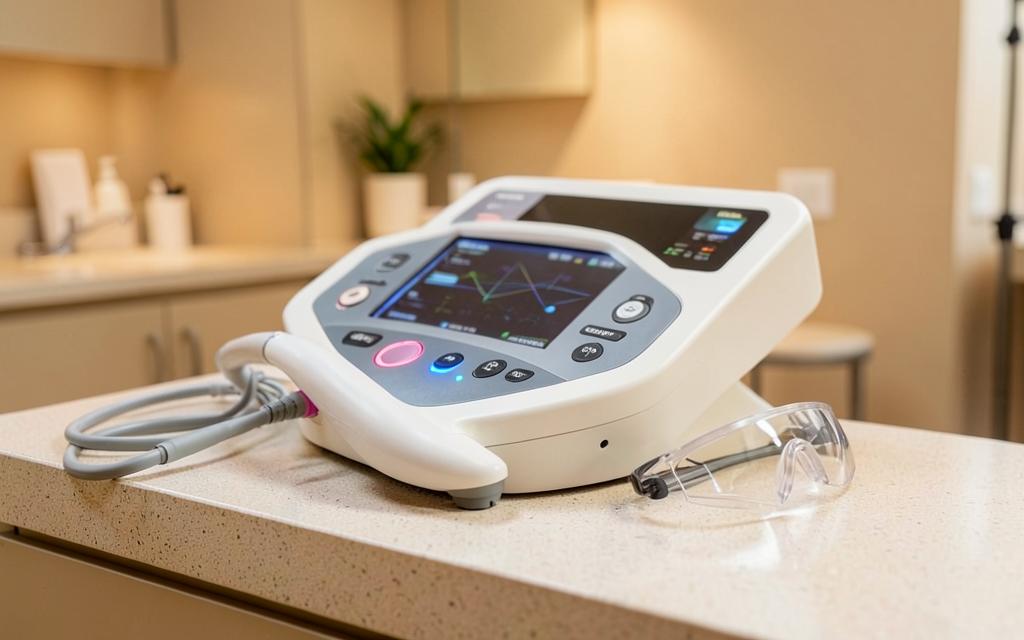
Intense pulsed light uses a flashlamp that emits a broad band of wavelengths, filtered to target either melanin or haemoglobin. Because it is not a single wavelength device, one machine can address several problems, but it also delivers energy to any chromophore in its path, which is why patient selection and filter choice matter more than with a laser [1].
Key points
- Best evidence is in facial redness, telangiectasia, rosacea and solar lentigines
- Used for hair reduction on light to medium skin, but laser is preferred in darker skin
- Not suitable for tanned skin, and generally avoided in Fitzpatrick types five and six
- A course of three to five sessions four weeks apart is typical
- It is not a treatment for melasma and can make melasma worse
How it works
The flashlamp emits light between roughly 500 and 1200 nanometres. Cut off filters block shorter wavelengths so that the remaining light is preferentially absorbed by the intended target: oxyhaemoglobin in vessels or melanin in pigmented lesions. Absorbed light converts to heat and selectively damages the target while the surrounding tissue cools [1].
This is called selective photothermolysis. Its success depends on there being more of the target chromophore in the lesion than in the surrounding skin, which is precisely the problem in darker skin where background epidermal melanin competes for the energy.
What IPL treats well
Vascular indications are the strongest: diffuse facial redness, fine telangiectasia, erythematotelangiectatic rosacea, poikiloderma of the neck and chest. Multiple sessions reduce background redness and flushing, and maintenance once or twice a year is typical.
Pigmented indications include solar lentigines and freckles on sun exposed skin, which darken and flake off over a week after treatment. Photodamaged chest and hands respond well when the skin is not tanned.
- Facial redness and rosacea
- Telangiectasia and poikiloderma of the neck
- Sun spots and freckles on untanned skin
- Hair reduction in lighter phototypes
- Adjunct in acne through the effect on Cutibacterium acnes porphyrins
Limits and risks in Middle Eastern skin
In Fitzpatrick types four and above, epidermal melanin absorbs a large share of the energy. This raises the risk of burns, blistering, hypopigmentation and post inflammatory hyperpigmentation. Many practitioners avoid IPL entirely in types five and six and use long pulsed Nd:YAG laser instead for vessels and hair [2].
Recent sun exposure is a temporary contraindication for anyone, and a four week gap from any tanning is a minimum. A test patch is strongly advised before a first treatment in medium or darker skin.
Melasma: the important exception
IPL can appear to lighten melasma initially and then cause a marked rebound, because heat itself stimulates melanocytes. Guidance for melasma prioritises photoprotection, topical therapy and, where devices are used, low fluence approaches with caution rather than IPL [2].
A patient with brown facial patches needs a diagnosis before any device is used, since melasma, post inflammatory pigmentation, lentigines and pigmented contact dermatitis all look similar to the untrained eye and respond very differently.
The session and aftercare
Cool gel is applied, eyes are shielded, and the handpiece is placed with slight overlap across the area. Sensation is a hot snap like an elastic band. A face takes fifteen to twenty minutes.
Expect mild redness and warmth for a few hours, and darkening of pigmented spots that flake over five to seven days. Do not scrub these off. Sunscreen every morning and sun avoidance for two weeks are essential.
Frequently asked questions
Is IPL a laser?
No. A laser emits one wavelength, IPL emits a filtered band of many. This makes IPL versatile but less precise, which matters most in darker skin.
How many sessions will I need for redness?
Three to five sessions four weeks apart gives a substantial reduction for most patients, followed by maintenance once or twice a year.
Can I use IPL for hair on brown skin?
It is not the safest choice. Long pulsed Nd:YAG laser is preferred for hair reduction in darker phototypes because it largely bypasses epidermal melanin.
References
- [1] Babilas P, Schreml S, Szeimies RM, Landthaler M. Intense pulsed light: a review. Lasers in Surgery and Medicine. Source
- [2] Alexis AF. Lasers and light based therapies in ethnic skin. British Journal of Dermatology. Source
This content is general medical education and does not replace a personal consultation. Any prescription must be coordinated with your local doctor.
Is this procedure right for you?
Book a video consultation to discuss your case, or a clinic visit in Baghdad or Karbala.